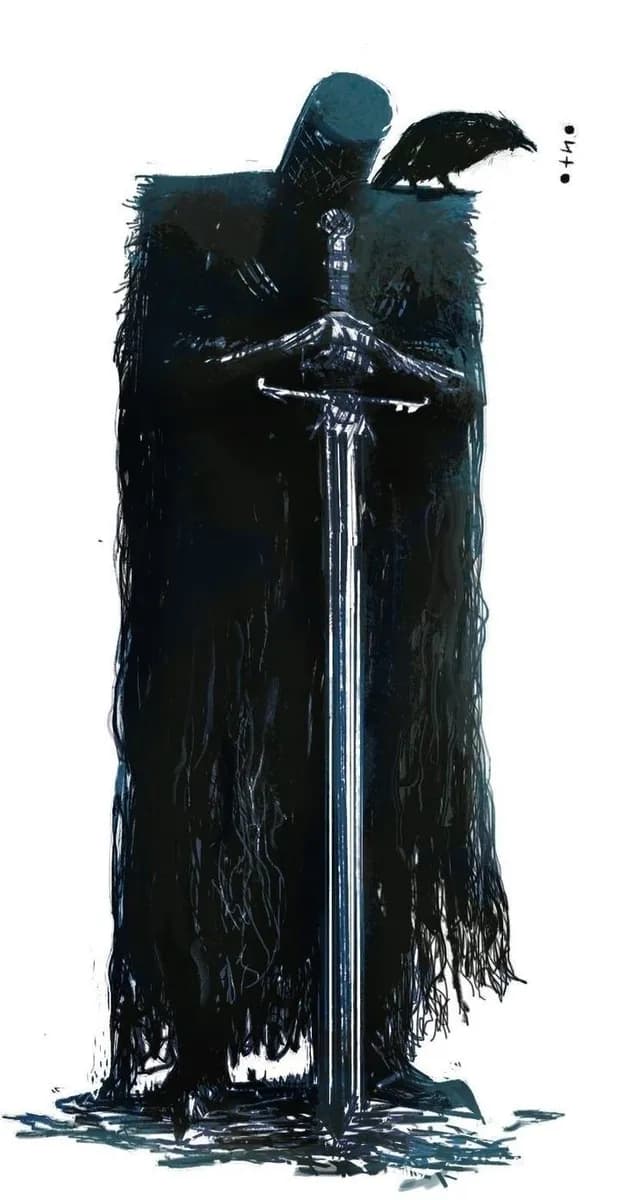
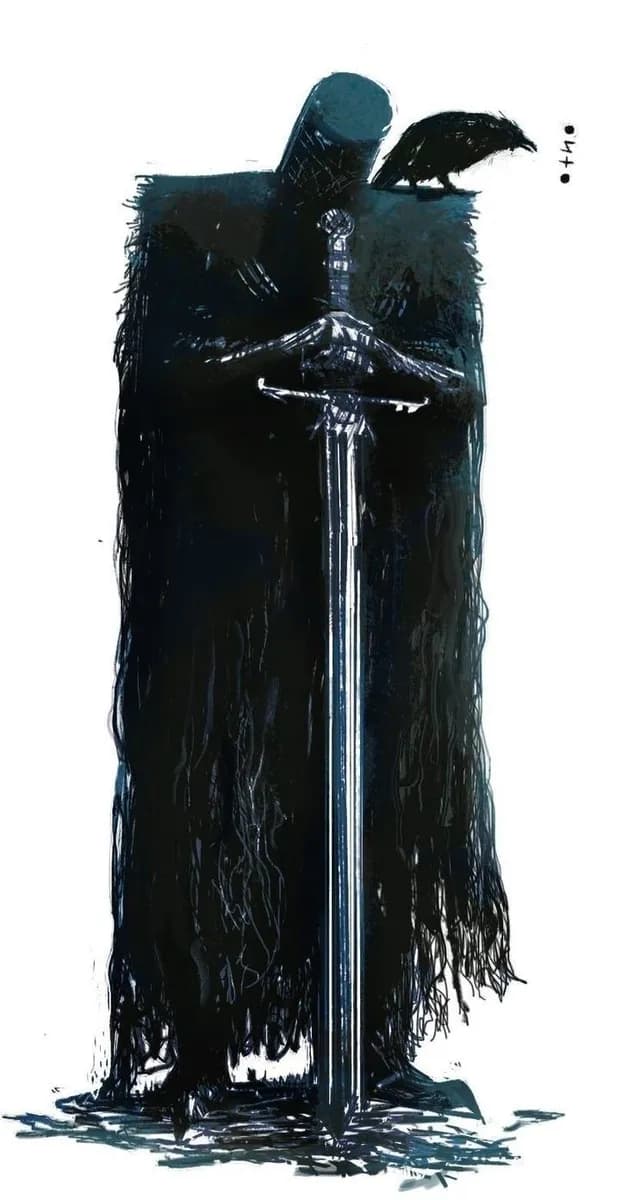
Here is the updated wiki page for The Penitent Knight, with the physical description corrected to match the base armor artwork.
---
== The Penitent Knight ==
{{Infobox character
| name = The Penitent Knight
| title = The Knight of Unending Atonement
| weapon = Remorse (cursed blade)
| armor = Cursed Armor of Atonement
| abilities = Absolution, Pain Absorption, Damage Conversion
| affiliation = Unknown; bound to a nameless sin
| status = Wandering, seeking impossible redemption
}}
'''The Penitent Knight''' is an unnamed, guilt-bound warrior who walks the battlefields of a shattered world bearing two inseparable curses: a sword that feeds on the agony of others, and an armor that drinks his own suffering. Every fight he survives brings him closer to annihilation, yet he marches forward—not for victory, but for penance.
== Origin and Curse ==
The Knight’s past is a closed book written in scar tissue. What is known is etched directly into his gear: he committed a sin so profound that ordinary death could not balance the scales. The sword '''Remorse''' and the '''Cursed Armor of Atonement''' were forged not as weapons of war, but as instruments of eternal punishment, bonded to his soul until the debt is paid.
The mechanics of the curse are cruelly precise. The more he fights, the more powerful he becomes—and the closer he comes to self-destruction. He is not permitted a quick death, nor an easy victory. He must feel every ounce of harm he inflicts and endures, carrying the accumulated weight until he chooses to release it in a single, life-draining act of devastation. The question of who placed this curse, and whether absolution is even attainable, remains the silent engine of his tragedy.
== Personality ==
The Penitent Knight is '''silent, resolute, and endlessly weary'''. He does not boast, plead, or explain. When he speaks, his voice is a low rasp, as if the words themselves are being dragged through gravel and regret. He exhibits no self-pity; he has moved beyond it into a state of grim, mechanical purpose.
His defining trait is an unshakeable sense of debt. He views every wound he receives and inflicts as a payment toward a balance he can never fully see. He fights not out of bloodlust, but obligation. He protects the innocent not from heroic impulse, but because allowing harm to happen in his presence would add to his moral ledger. He is, in effect, an accountant of agony—constantly tallying a sum he hopes will one day read zero, knowing it never will.
Beneath the steel and sorrow, a spark of the man he once was occasionally surfaces. He polishes his sword not for sharpness, but out of ritual respect. He kneels beside fallen enemies, murmuring a single word that might be a prayer or an apology. These gestures are the only evidence that the curse has not yet hollowed him out entirely.
== Physical Appearance ==
The Penitent Knight is a monolithic, statuesque figure rendered almost as a living gothic painting—tall, imposing, and wreathed in impenetrable shadow. Deep blacks dominate his silhouette, accented by subtle undertones of dark teal and blue, with sharp white highlights defining the heavy folds and textures of his ancient vestments.
He is draped in a voluminous, tattered black cloak that falls heavily to the ground in ragged, frayed layers. The fabric appears centuries old, weathered beyond mortal lifetimes, its edges torn into thread-like strands and irregular shapes. The robe pools around him like liquid night, every crease catching an unseen, dramatic light. No conventional armor plates are visible; the cloak itself seems to be the armor, a cursed, animate shroud that drinks in the violence of the world.
Atop his shoulders rests a distinctive, dark helmet with a cylindrical, flat-topped shape, like a tall pillbox or a truncated column. The helmet completely conceals his head and face, but unlike a typical helm, it offers no visor, no ocular slit, no trace of a face beneath. It presents a stark, featureless void—an abyss of impenetrable shadow where a face should be. The metal is solid, clean-lined, and geometric, in stark contrast to the ragged chaos of the cloak below.
The only part of his body that remains visible are his hands, wrapped around the grip of Remorse. They are pale, bony, and skeletal, with long, articulated fingers that appear almost claw-like. Whether they are gauntleted or truly fleshless bone is unclear, but they speak to an entity that has long since passed beyond normal human vitality. The overall impression is that of a death knight, a dark paladin, or an ancient wraith-like guardian—a silent, moving monument to sorrow.
== Powers and Abilities ==
Every ability is a double-edged clause in a supernatural contract written in his own blood.
=== Divine Penance (Sword: Remorse) ===
The blade '''Remorse''' does not cut flesh in the conventional sense; it cuts into the nerve of suffering itself. With each successful strike, the sword drains the pain from the enemy—not just physical agony, but buried guilt, grief, and fear—and stores it within the blade. Visually, the sword grows darker, heavy with stolen anguish, droplets of shadow bleeding from its edge.
Once enough pain has been harvested, the Knight can unleash '''Absolution''', a massive, area-obliterating attack that releases the accumulated suffering in a single detonation of force and light. Absolution deals immense, often decisive, damage. However, the release is reciprocal: the Knight's own life force is consumed as the catalyst. He does not channel the pain—he echoes it through his own soul, paying with years of life, consciousness, or a piece of his remaining humanity. A fully charged Absolution leaves him kneeling in the crater, barely breathing.
=== Cursed Armor of Atonement ===
The cursed cloak and helm are a martyr’s engine, an armor of attrition rather than mere metal. Every blow the Knight receives is partially absorbed by the shadow-draped vestment, the impact energy converted into raw power rather than lethal trauma. This makes him increasingly stronger as the battle rages; his strikes land harder, his endurance extends, and the threshold for what is considered “damage” grows.
This boon carries a crushing drawback: the same mechanism that converts pain into strength also increases the armor’s density. The Knight becomes progressively slower, each movement requiring monumental effort. The heavy cloak drags ever more weightily, the helmet becomes a crushing burden, and the skeletal hands must fight against a force that seeks to freeze them in place. A prolonged fight becomes a lethal drag race between accumulating unstoppable force and total immobilization. If the battle does not end in time, he will become a statue of his own invincibility—still alive, still conscious, and permanently frozen, unable to fall or rise.
== Paraphernalia ==
· '''Remorse (Cursed Sword):''' A two-handed greatsword with a blade the color of tarnished silver, its fuller filled with a dark, viscous substance that pulses like a slow heartbeat. The hilt is wrapped in leather worn smooth by skeletal fingers. It hums faintly when near a being with hidden guilt.
· '''Cursed Armor of Atonement:''' A voluminous, tattered black cloak and featureless cylindrical helm, fused not to his body but to his fate. The fabric is animated by a dark will, absorbing punishment and growing heavier with every blow. The helm offers no glimpse of the man beneath—only an impenetrable void.
· '''The Chain of Oaths:''' Around his left wrist, barely visible beneath the ragged sleeve, hangs a single rusted chain with a broken pendant. The shape is unrecognizable—a symbol of a broken vow, or the last remnant of someone he loved before the fall.
== Combat Philosophy ==
The Penitent Knight’s fighting style is a brutal calculus of suffering. He does not dodge frivolously; he accepts hits that a sane warrior would avoid, knowing the cloak will convert the pain into future strength. He targets enemies not to kill quickly, but to extract maximum pain for Remorse to store, trying to build enough charge for one perfect, battle-ending Absolution. Every engagement is a countdown: he must deal enough damage and absorb enough punishment to unleash the final blow before his body grinds to a halt. To watch him fight is to watch a man performing a high-wire act over an abyss of his own making.
== Thematic Interpretation ==
The Penitent Knight is the living embodiment of the question: '''Can suffering ever repay a debt, or does it merely spread the weight?'''
He turns pain into currency. He is a grim alchemist, transmuting agony into power, yet the economy of his existence is a closed loop of loss. The sword takes from enemies, the cloak takes from him, and Absolution takes from both. He is a man running a marathon in a shroud of shadows, not toward a finish line, but toward an end he can accept.
His themes are atonement without guarantee, endurance as a form of self-annihilation, and the horrific reality of a redemption that demands everything and promises nothing. There is no divine voice assuring him of forgiveness; there is only the road, the next battle, the next payment. The armor's slowing effect is the cruelest metaphor of all: the stronger he becomes in his quest for absolution, the closer he comes to complete paralysis—a final state where he can no longer act, only suffer silently, perhaps forever. Is that the true penance? To become an immobile witness to a world he can no longer touch?